The roar of the engine at the Michigan International Speedway drowns out everything else, but for Armani Williams, the vibration of the seat is the only language that finally made sense. At twenty-six years old, he is strapped into a machine designed to punish the senses, operating at speeds that would paralyze most drivers with fear.
The path to this cockpit didn’t start in a garage, but in a doctor’s office in Detroit where his parents were told their two-year-old son was nonverbal. The diagnosis was autism, a label that, in the early 2000s, often functioned as a closed door on a child’s future potential.
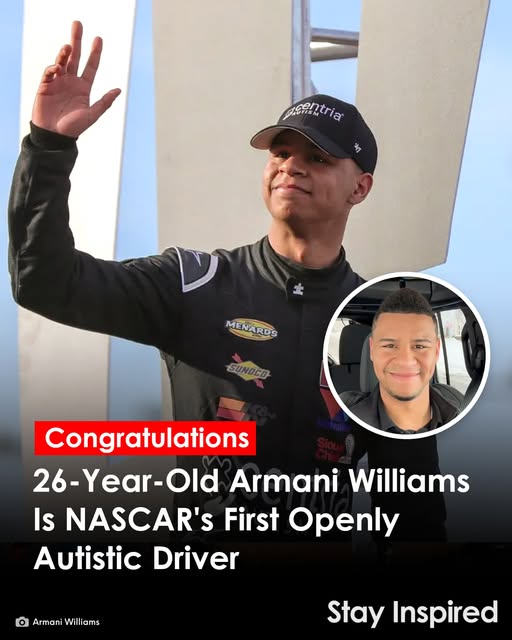
While other children were learning to form sentences, Williams was learning the geometry of race tracks. He found his voice not through vocal cords, but through the mechanical feedback of a go-kart steering wheel at the age of eight, beginning a relentless climb through the ranks of competitive racing.
The data doesn’t lie: by 2018, Williams was competing in the NASCAR K&N Pro Series. He wasn’t just participating; he was recalibrating what it means to be a professional athlete in a sport that demands hyper-focus and split-second sensory processing.
His father, Del Williams, describes the journey as a decade-long exercise in support and survival. He watched a son who couldn’t communicate his basic needs as a toddler evolve into a driver who communicates with precision at 200 miles per hour, forcing the racing world to acknowledge a talent they previously had no framework for.
The human cost of this achievement is the invisibility of the struggle. For every Armani Williams who reaches a professional track, thousands of others are sidelined by educational systems and social structures that view their neurodivergence as a deficit rather than a different operating system.
Williams now spends his time off the track speaking to children who feel isolated by their own silence. He tells them to believe in themselves, but the reality is that he had to fight for a seat in a world that never intended to offer him one.
We label this a ‘history-making’ moment to make ourselves feel better about the progress we think we’ve made. But the question remains: why is he still the only one? If the talent is there, what is it about our systems that keeps the cockpit door locked for everyone else?
Is this the start of a new era in NASCAR, or just a rare exception that proves how narrow the path really is for those who are different?